
Before there was money, there was the handshake. Before there was a signature, a contract, or a notary, there was one open hand meeting another — and somehow, that was enough to close a deal.
It's not an accident that this company is called SHAKE. The gesture is one of the oldest pieces of technology humans ever built for solving a very specific problem: how do two strangers agree to trust each other, right now, with nothing but their word?
The Weapon in Your Hand
The most widely cited explanation for the handshake is disarmingly literal. In much of the ancient world, the right hand was the weapon hand — the one that drew a sword, gripped a spear, or palmed a hidden blade. Extending that hand, open and empty, toward a stranger was a direct physical statement: I could hurt you. I am choosing not to.
The handshake didn't start as a greeting. It started as proof of non-aggression — the oldest trust signal we have.
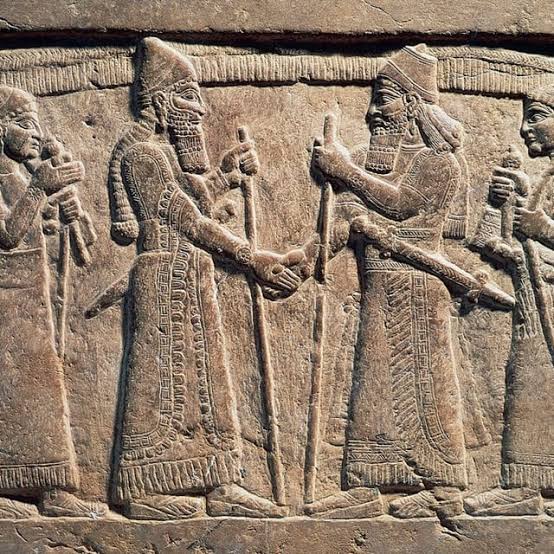
The earliest known depiction of the gesture backs this up, and it's remarkably old. A 9th-century BC Assyrian stone relief from Nimrud, in modern-day Iraq, shows King Shalmaneser III clasping hands with a Babylonian ruler to seal a military alliance. It wasn't decoration — it was diplomacy, carved permanently into the base of a throne so nobody could later claim the pact hadn't happened.
By the 5th century BC, the ancient Greeks had formalized it further. They called it dexiosis, and it shows up again and again in Homer's Iliad and Odyssey — almost always attached to a pledge, an oath, or a display of trust between people who had every reason not to trust each other.
Rome's Sacred Handclasp
The Romans took the idea somewhere even more permanent: marriage. The dextrarum iunctio — literally "joining of right hands" — appears on countless Roman sarcophagi, coins, and wedding reliefs, showing a bride and groom clasping hands under the watch of Fides, the Roman deity of trust and good faith.
The Romans didn't reserve the handclasp for business. They used the exact same gesture to seal a marriage as they did to seal a treaty — because to them, it was the same underlying promise: I am bound to this, and I want you to see me commit to it.
That symbolism didn't disappear with Rome. Early Christian mosaics — including scenes as old as Moses and Zipporah's marriage at Santa Maria Maggiore in Rome — reused the same clasped-hands motif centuries later. Different religion, same gesture, same job: make a private promise visible and permanent.
Where "Shake On It" Actually Comes From
The English language kept the gesture alive in its own vocabulary, and the etymology is more literal than most people realize. "Shake on it" traces back to Old English handfæsten and Old Norse handfesta — both of which meant, quite directly, "to pledge, to betroth, to strike a bargain by shaking." The phrase "a fair shake," meaning an honest deal, shows up in American English as early as 1830.
"Strike a deal" has the same physical root. From the mid-15th century, "strike" was already being used to mean reach or conclude an agreement — almost certainly from the older practice of two parties literally striking or clapping their hands together to close a bargain in public, where witnesses could see it happen.
"Striking" a deal and "shaking" on it aren't just figures of speech. Both phrases describe an actual physical gesture that used to be the entire contract.
What Your Brain Actually Does When You Shake
This is where it stops being folklore and starts being measurable. In 2019, researchers from UC Berkeley's Haas School, the University of Chicago's Booth School, and Harvard Business School — Juliana Schroeder, Jane Risen, Francesca Gino, and Michael Norton — published a six-study investigation in the Journal of Personality and Social Psychology called "Handshaking Promotes Deal-Making by Signaling Cooperative Intent."
Their findings are genuinely striking:
- Negotiating pairs who chose to shake hands before an integrative (win-win) negotiation walked away with better joint outcomes than pairs who didn't.
- The effect held even when the handshake was uninstructed — people who spontaneously chose to shake hands did better, without being told to.
- Executives assigned to shake hands before a tougher, more adversarial negotiation were less likely to lie about information that would have benefited them — even when lying would have worked in their favor.
- And in a fascinating reversal: when a handshake signaled bad intent (in one study, when the person shaking hands was framed as being unwell), the effect flipped entirely — cooperation actually dropped.
It's not the physical contact itself that does the work. It's what the handshake tells your brain about the other person's intentions. A handshake that signals good faith increases cooperation. A handshake that signals a threat decreases it. The gesture is a messenger, not magic.
That last point matters more than it sounds like it should. A handshake isn't a lucky charm — it's a signal, and your brain reads it the same way it reads a tone of voice or a facial expression, almost instantly, before you've consciously decided anything about the person in front of you.
The Oxytocin Question
You'll often hear that handshakes work because physical touch releases oxytocin — the so-called "trust hormone" — and that this is the biological mechanism behind why the gesture builds cooperation. There's real research behind part of this: a landmark study by Michael Kosfeld and Ernst Fehr, published in Nature, found that oxytocin measurably increased people's willingness to trust a stranger, and later work has linked oxytocin to stronger behavioral synchrony between two people interacting.
It's worth being honest about the limits here, though: more recent research has raised serious methodological concerns about parts of the oxytocin-and-trust literature, and the field is actively being revised. The safest conclusion isn't "shaking hands floods your brain with a trust chemical, therefore deals close." It's narrower and still interesting: touch and physical synchrony appear to be involved in how humans build trust quickly — the full biological story just isn't as settled as the popular version suggests.
The Pandemic Test
If you want proof of how socially load-bearing this small gesture really is, the COVID-19 pandemic ran the experiment for you. Handshakes were among the very first casualties of 2020 — Dr. Anthony Fauci went as far as saying, on record, "I don't think we should ever shake hands ever again."
He was wrong, and the speed of the reversal is the interesting part. By 2022, corporate handshakes were already back in most business settings. By 2024, the elbow-bump experiment was largely over. A gesture that public health officials predicted might disappear for good came back almost as fast as it left — because nothing else people tried (fist bumps, elbow taps, waves) did the same social job. We apparently needed it.
Why This Company Is Called SHAKE
None of this is really about etiquette. It's about a problem that's existed for as long as trade has: two people who don't fully know each other need a fast, low-cost way to agree that this transaction is safe to make.
For thousands of years, the answer was a physical gesture — visible, mutual, impossible to fake convincingly, carrying real information about the other person's intent. A marketplace is solving exactly the same problem at scale: a buyer and a seller who've never met, agreeing to trust each other enough to do business.
The handshake survived money, writing, the printing press, the telephone, the internet, and a global pandemic — because nothing has ever fully replaced what it does. It's still the fastest way two people can say, in public, "I mean this."
Final Insight
The handshake isn't a formality left over from a more polite era. It's a several-thousand-year-old piece of social technology, refined across Assyrian diplomacy, Greek oaths, Roman marriage law, and modern negotiation science, that still does one job better than almost anything else humans have invented since: it lets two people agree, instantly and visibly, to trust each other.
Every deal made through this marketplace is still, underneath the listings and the messages and the price negotiations, exactly that same old handshake — just at a distance, and at scale.