
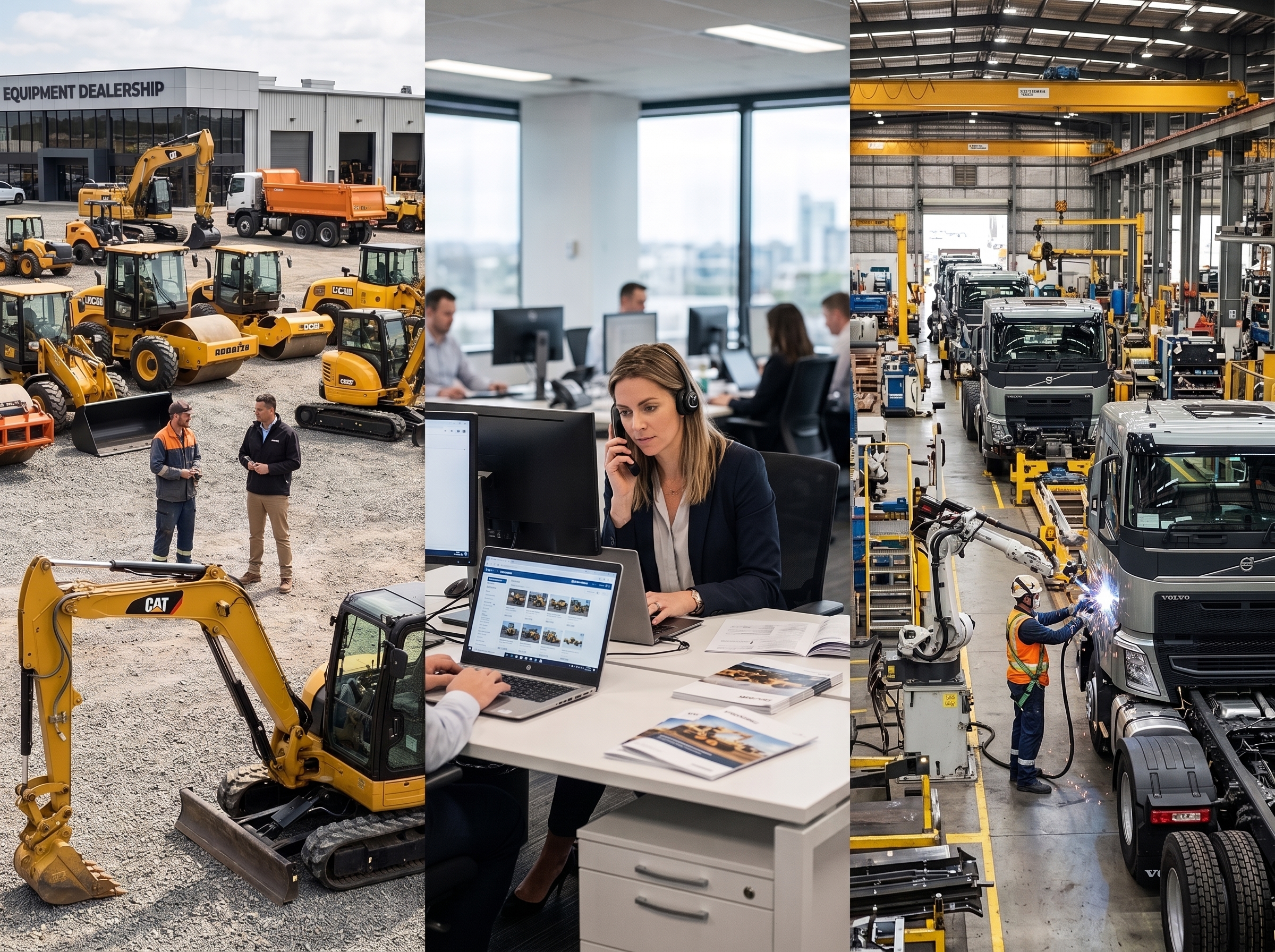
Most people think a machinery marketplace simply connects buyers with sellers. In reality, it connects several different types of businesses — each serving a unique role in keeping South Africa's equipment moving.
A healthy marketplace isn't built around one seller type. It's built around an ecosystem.
1. Equipment Dealers: The Foundation of the Market
Dealers form the backbone of South Africa's used equipment market. They typically trade in machinery, recondition equipment, offer financing relationships, accept trade-ins, provide after-sales support, and hold inventory ready for immediate purchase.
Because they maintain stock year-round, dealers account for a large share of machinery transactions in the organised used-equipment market. For many buyers, they provide the lowest-risk purchasing option.
2. Manufacturers & OEMs
Original Equipment Manufacturers (OEMs) and their dealer networks primarily sell new machinery, but many also handle demonstration units, dealer trade-ins, certified pre-owned equipment, and fleet replacements.
South Africa's agricultural equipment market is largely supplied through international manufacturers working with local distributors and dealer networks. These businesses introduce new equipment into the market — and much of tomorrow's used machinery begins here.
3. Equipment Brokers
Not every seller owns the machine they advertise. Brokers connect buyers and sellers without necessarily carrying inventory themselves. Their value comes from industry relationships, market knowledge, nationwide sourcing, and faster matching of buyers and sellers.
For buyers searching for a specific machine, a broker can often locate equipment that isn't publicly advertised.
4. Auction Companies
Auctioneers play an important role when equipment needs to move quickly. Common sources include farm dispersal sales, business liquidations, fleet renewals, insolvencies, and estate sales.
Auctions increase market liquidity by moving large volumes of machinery in short periods, creating opportunities for both buyers and sellers.
5. Contractors & Fleet Operators
Large contractors regularly renew their fleets. Rather than waiting until machines reach the end of their lives, many sell equipment while it still has strong resale value. These machines often come from earthmoving fleets, agricultural contractors, forestry contractors, and transport businesses.
Fleet renewals create a steady supply of relatively modern used equipment entering the market.
6. Farmers Selling Directly
Many farmers occasionally sell machinery that no longer fits their operation — upgrading to larger equipment, changing farming practices, retiring machinery, or reducing fleet size.
While individual farmers may sell less frequently than dealers, collectively they represent an important source of quality used equipment.
7. Finance & Asset Recovery Companies
Banks and finance providers occasionally recover financed equipment. These machines are usually sold through dealers, brokers, auction houses, or specialised remarketing partners.
Although this represents a smaller portion of the market, it provides another pathway through which machinery returns to active use.
Why SHAKE Brings Them Together
Each seller serves a different purpose. Dealers provide confidence. Manufacturers introduce new equipment. Brokers find hard-to-source machines. Auctioneers create liquidity. Contractors renew fleets. Farmers supply well-maintained used equipment. Finance companies return repossessed assets to the market.
| Seller Type | Holds Inventory | Trade-Ins | Financing | Typical Stock |
|---|---|---|---|---|
| Dealer | Yes | Yes | Yes | High |
| OEM | Yes | Yes | Yes | New & Demo |
| Broker | No | Sometimes | No | Sourced |
| Auctioneer | Temporary | No | No | Variable |
| Contractor | Yes | No | No | Fleet Renewal |
| Farmer | Yes | No | No | Occasional |
Individually, each group serves part of the market. Together, they create a complete machinery ecosystem.
A marketplace becomes truly valuable when buyers don't need to know who has the machine — they simply know they'll find it there.
Final Insight
The South African machinery market isn't driven by a single type of seller. It's powered by a network of businesses that buy, sell, trade, refurbish, source, finance, and redistribute equipment throughout its lifecycle.
The strongest marketplaces don't compete with these businesses. They connect them. That's how more machines find the right owners — and how the entire industry becomes more efficient.